Alliance Manager Job Description: What a Partner-Side Alliance Role Actually Does

Altamiq
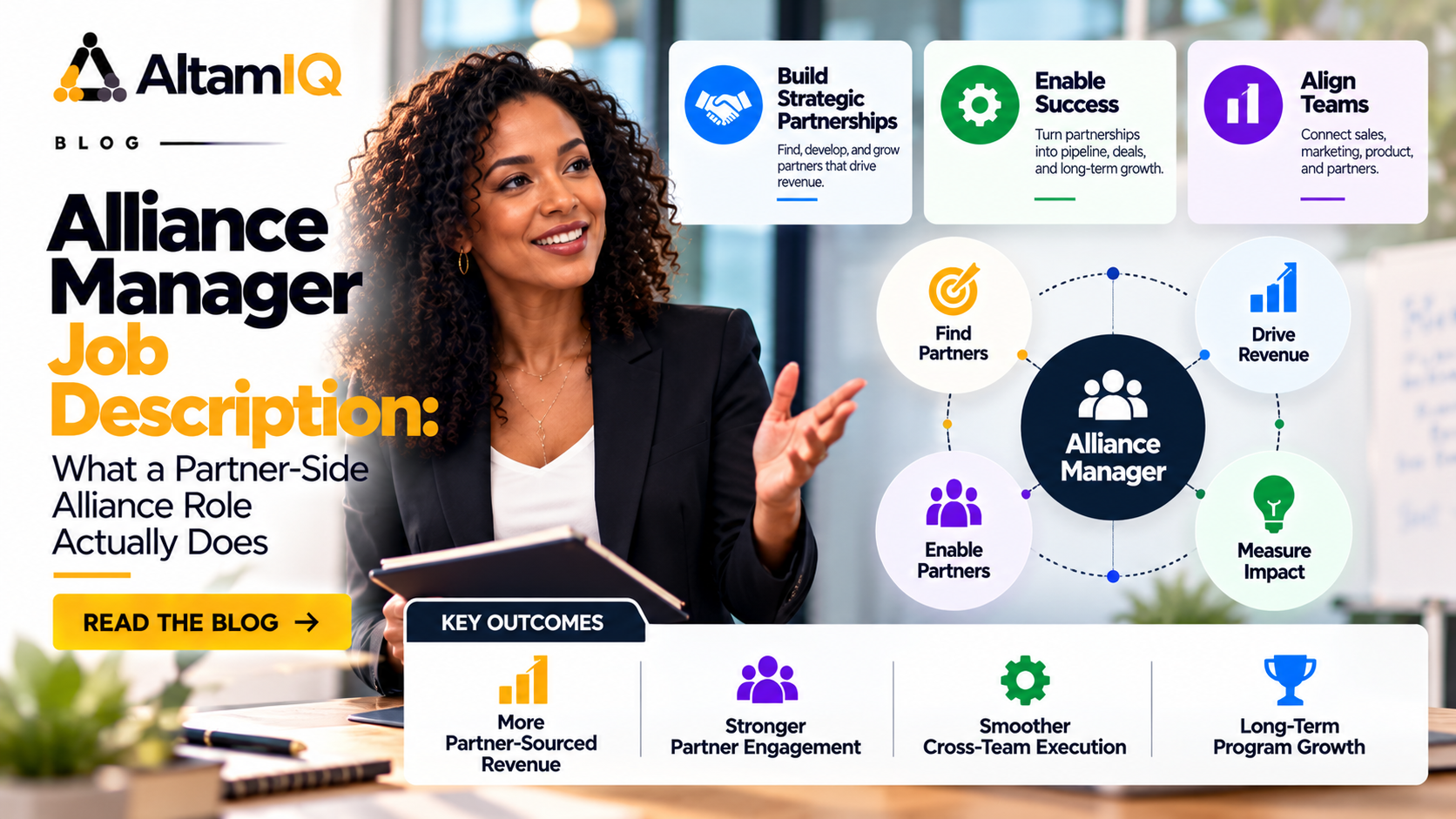
Search for an alliance manager job description and nearly every result describes a vendor-side role: someone who recruits, enables, and supports channel partners. There is a second role with the same name that few write about, and it sits on the partner side. This person manages the firm’s relationships with its vendors.
Search interest is modest. Ahrefs shows about 30 monthly US searches for “partner manager job description” and about 20 for “alliance manager job description,” with very low difficulty. The audience that does search is typically a founder or operations leader deciding whether the firm needs this role at all.
Why the role exists
A partner-side alliance manager exists because vendor relationships have become an operation. A firm holding many programs carries certification schedules, tier requirements, registration windows, funds, and agreement terms. When nobody owns them, they are managed by whoever notices.
Core responsibilities
| Area | What the role does | Output |
| Portfolio visibility | Maintains one record of every vendor, tier, requirement, and date. | Portfolio view reviewed monthly |
| Compliance and renewals | Tracks certifications, assessments, and agreement renewals; plans ahead. | Renewal calendar, no surprise expiries |
| Deal protection | Owns deal registration across vendors. | Registration log, extension requests |
| Funds and incentives | Finds, plans, and claims MDF and rebates. | Funds ledger, claims submitted on time |
| Vendor reviews | Prepares and leads business reviews; holds vendors to commitments. | Review packs, action lists |
| Change monitoring | Reads program announcements and assesses the impact. | Change log with decisions |
| Advice to leadership | Recommends where to invest, hold, or exit. | Twice-yearly portfolio recommendation |
Skills and experience
- Commercial judgment. Can read a program’s economics and tell a good tier from an expensive one.
- Operational discipline. Dates, owners, and follow-through matter more here than charisma.
- Relationship skills. Works with vendor partner managers without becoming dependent on them.
- Technical literacy. Understands enough about the products to see what certifications and requirements actually imply.
- Analytical habit. Comfortable with a scorecard, a ledger, and a spreadsheet.
What success looks like in the first year
- A single record of the portfolio exists and is trusted.
- No certification, registration, or fund has lapsed unnoticed.
- Each core vendor has a written tier plan and a review cadence.
- Leadership has seen a scorecard and made at least one invest or exit decision from it.
Do you need a full-time hire?
Not always. The role can be a share of someone’s week in a smaller firm. The signal that it needs an owner is the first missed expiry, or the first moment someone asks which vendors the firm is actually profitable with and nobody can say.
Make the role effective: Whoever holds it needs three things: access to every vendor portal, authority to ask engineers about their certification plans, and a standing slot in leadership meetings. Without those, the role becomes administration.
A short job description you can adapt
Alliance Manager (Vendor Programs). You will own our relationships with the technology vendors we partner with. You will keep a complete record of our standing, certifications, registrations, and funds across vendors; plan renewals and tier progression; lead vendor business reviews; and advise leadership on where to invest. You will work with delivery, sales, and finance. Experience with partner programs, strong organization, and commercial judgment are required.
Adjust the language to your firm, and add compensation and location details.
Interview questions that reveal the right candidate
The role sits between commercial judgment and operational discipline. Interview for both.
- “Tell me about a vendor program you decided to leave, or would have left. How did you decide?” Listen for numbers, not feelings.
- “You learn that a vendor is changing its tier requirements in 60 days. What do you do in the first week?” Strong answers describe assessing exposure and telling affected people.
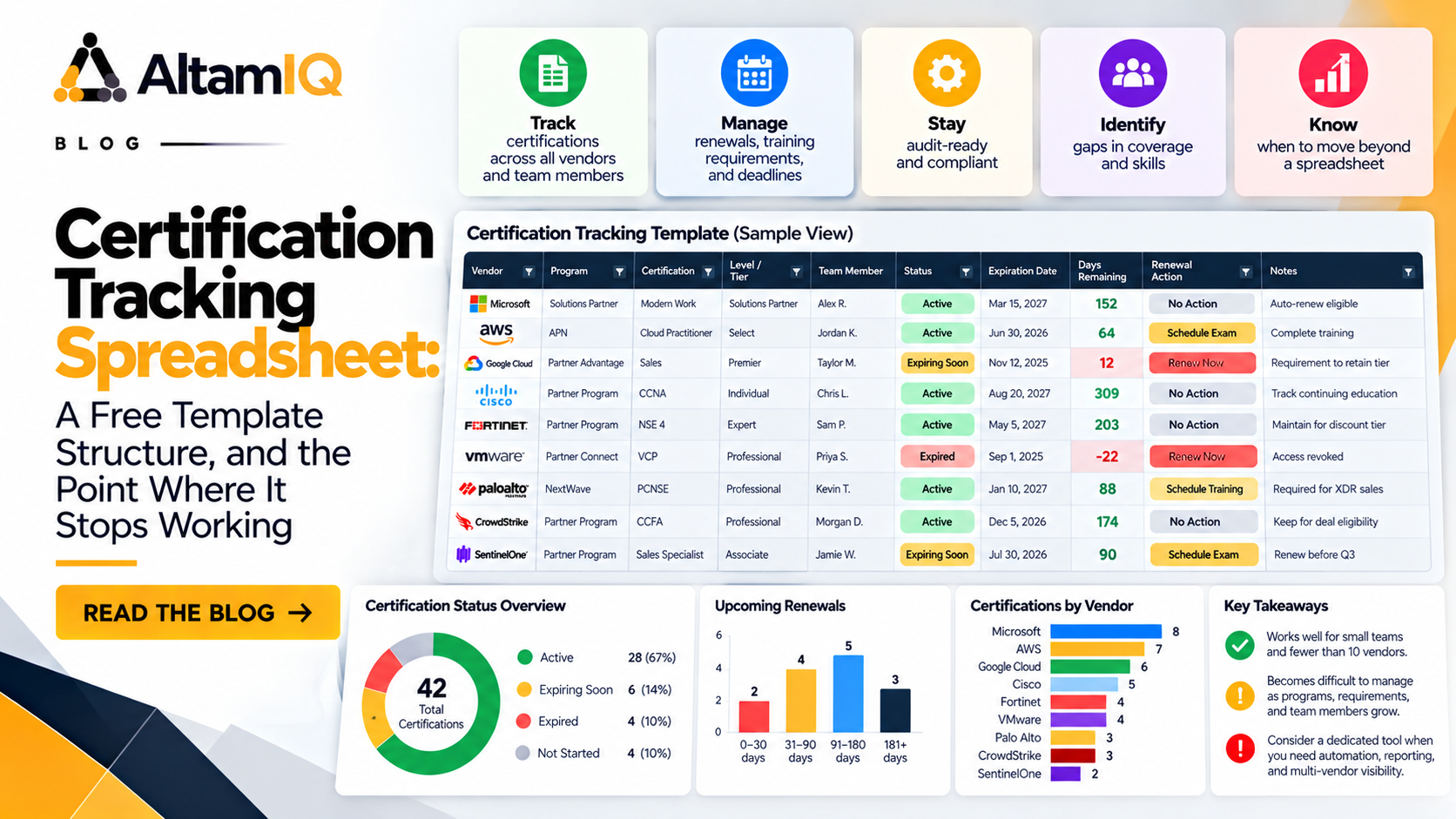
- “How would you track certifications across ten vendors?” The answer should include owners, dates, and a regular review, not only a tool.
- “A partner manager at a key vendor is unresponsive. What do you do?” Look for escalation paths and documentation.
- “How would you show leadership whether a vendor is worth the effort?” Listen for cost and return, not enthusiasm.
A 90-day plan for the new hire
| Period | Priorities | Deliverable |
| Days 1–30 | Meet every vendor contact. Build the inventory of programs, owners, and dates. | Portfolio record, version one |
| Days 31–60 | Identify the top risks: expiries, concentrations, open registrations. | Risk list with owners |
| Days 61–90 | Start the review cadence. Present the first scorecard to leadership. | First portfolio review |
How the role grows
In the first year the role is largely about bringing order. In the second, it turns strategic: advising on which programs to deepen, which to leave, and how to use vendor relationships to win work. Firms that hire for the second-year role from the start tend to get frustrated. Firms that give the new hire a clear first-year mandate, and a path to the second, tend to keep them.
Hiring tip: Do not hire for vendor knowledge alone. Vendors change, so the ability to learn a new program quickly matters more than familiarity with any one of them.
Measures of performance for the role
| Measure | What it shows | Target direction |
| Unplanned expiries | Whether renewals are under control | Zero |
| Share of eligible deals registered | Whether deal protection is working | Rising |
| Funds claimed against available | Whether vendor money is being used | Rising |
| Time to answer “where do we stand?” | Whether the record is usable | Minutes |
| Vendors with a current tier plan | Whether relationships are managed | All core vendors |
Choose three of these and review them quarterly. Fewer measures with real follow-up beat a long list that nobody reads.
Common pitfalls when hiring
- Hiring a former vendor partner manager and expecting the same job. The incentives are different on this side of the table.
- Giving the role responsibility without authority over certification plans.
- Treating it as administration and paying accordingly, then losing the person when they realize how strategic it is.
Where the role sits in a small firm
In a firm of 20 to 50 people, the alliance owner rarely has a full-time title. The function is often split between the managing director, an operations manager, and a delivery lead, each holding a piece. That works until the pieces drift. The practical fix is to name one person as the owner of the cross-vendor record and give them a fixed slot in the leadership meeting, even if the rest of the work stays distributed. Doing so converts a scattered responsibility into a visible one, and it makes the later decision to hire a dedicated role much easier, because you will know exactly what the job involves.
A part-time owner needs three things to succeed: a short list of what they are accountable for, enough time protected on their calendar, and the authority to ask colleagues for information. Without all three, the role collapses back into whoever notices.
A scenario: when the role pays for itself
A firm discovers during a bid that a required credential lapsed three weeks earlier. Nobody was responsible for noticing. Whatever the cost of that miss, it is a data point for the next hiring conversation. An alliance owner does not guarantee that no date is ever missed, but it gives the firm a person whose job is to catch them.
Frequently asked questions
Is this a technical or a commercial role?
Mostly commercial and operational, with enough technical literacy to understand what the requirements mean.
Where should the role report?
Typically to the COO or managing director, with a standing seat in leadership meetings.
Is this the same as a vendor’s partner manager?
No. A vendor partner manager works for the vendor. This role works for the firm holding the vendor relationships.
Further reading
- how Microsoft counts certified staff — How Microsoft counts certified staff toward a Solutions Partner designation: credit only for people linked to your organization, with expiring certifications flagged as a risk. (learn.microsoft.com)
- CompTIA research on vendor relationships (comptia.org)
- why partners underuse market development funds — A consulting-firm analysis of tiers and incentives: deal registration, rebates, MDF that often goes unclaimed because of complex rules, and certification bonuses. (alexandergroup.com)
AltamIQ: AltamIQ is built for this role: one portfolio of every vendor, requirement, certification, and date, so the person holding the relationships spends their week on decisions instead of rebuilding the picture from ten portals.
Sources & verification
- Keyword validation: Ahrefs Keywords Explorer, US — “partner manager job description” 30 searches per month, KD 0; “alliance manager job description” 20, KD 0.
- The job description is an original sample. No salary data is stated because none was verified.