AWS Partner Network Tiers for Multi-Vendor Firms: What Select, Advanced, and Premier Really Cost You in Certifications

Altamiq
Most of what is published about AWS Partner Network tiers is written for buyers deciding whether to hire a Premier partner. This post is for the other side of the table: the firm that holds the tier, has to keep it, and is also holding tiers, designations, and specializations from half a dozen other vendors at the same time.
The Services Path in one table
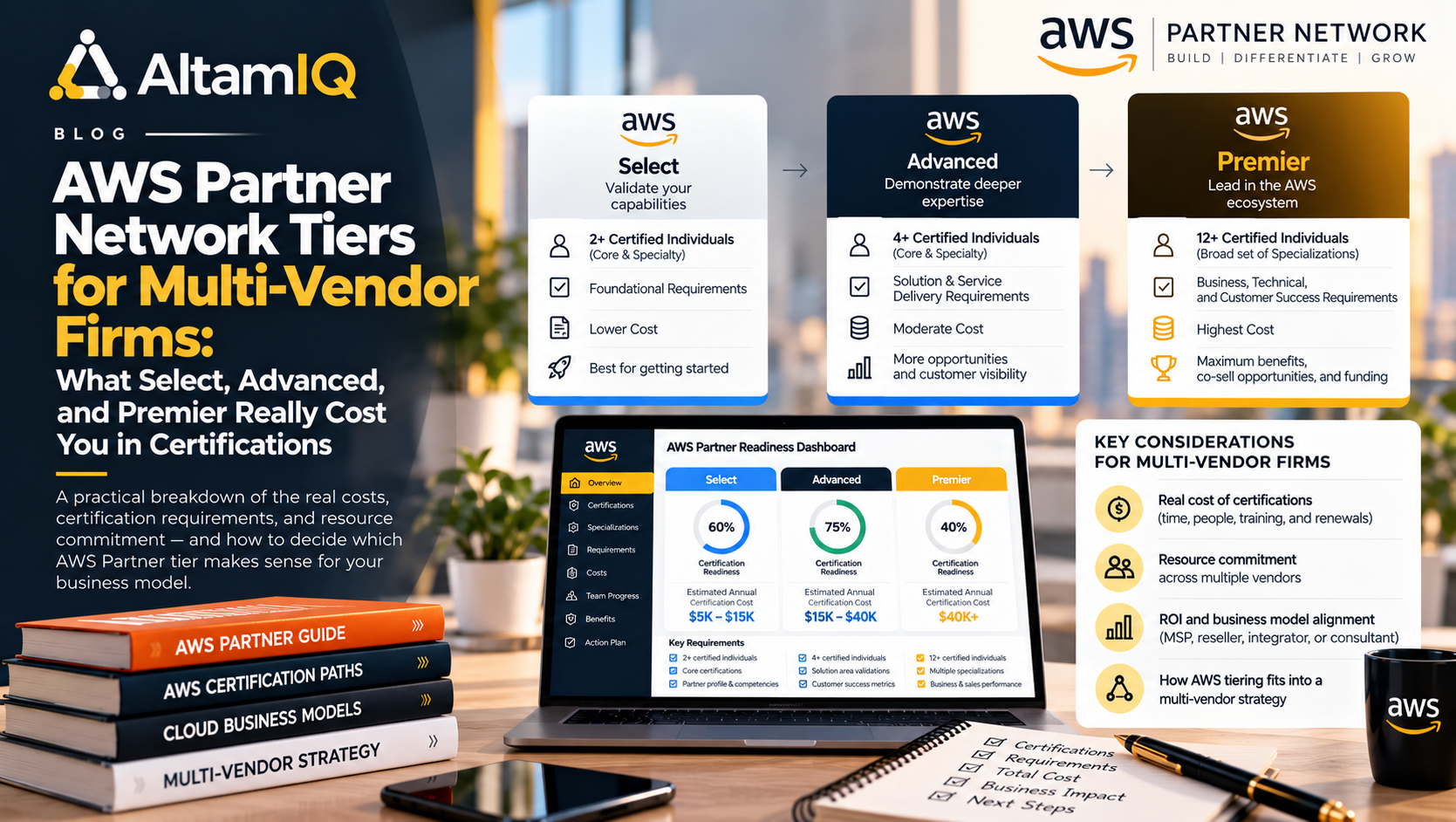
AWS organizes consulting and delivery firms on the Services Path, which replaced the older Consulting Partner model in January 2022. Above the entry-level Registered status there are three tiers. The figures below come from a May 2026 third-party summary of AWS’s published Services Tier requirements. Confirm the current thresholds in AWS Partner Central before you plan against them.
| Requirement | Select | Advanced | Premier |
| AWS Foundational certified individuals | 2 | 4 | 10 |
| Partner Business Plan | Not required | Required | Required |
| Well-Architected Partner Program eligibility | No | Yes | Yes |
| Sustained attainment | — | — | Advanced partners must meet and maintain Premier requirements for more than six months before applying |
Sources: third-party summary of AWS Services Tier requirements (May 2026); AWS Services Path tier guide as distributed by Westcon-Comstor. Verify in Partner Central.
The numbers look modest. Ten foundational certifications is not a hard bar for a 40-person cloud consultancy. The difficulty is not reaching the headcount. The difficulty is that the headcount is a moving target.
Why the certification count is really a calendar
AWS certifications are time-bound: they expire three years after you earn them and have to be renewed. Certifications also belong to people, and those people have to be registered to your AWS Partner Central account for the certification to count toward your tier. Put those two facts together and three predictable problems appear.
- The expiry cluster. Firms rarely certify evenly. A push to reach Advanced produces six or eight certifications in the same quarter, and three years later all six or eight expire in the same quarter. Unless someone has mapped that cliff, it arrives as a surprise.
- The departure gap. A certification does not transfer when an engineer leaves. If four of your ten Premier-qualifying certifications sit with the people most likely to be recruited away, your tier has a retention risk that no HR report will show you.
- The registration gap. A certified person who is not linked in Partner Central does not count. This usually surfaces when someone joins from another employer. They hold the certification, but nobody attaches them to the account.
The six-month rule changes the math: Advanced partners applying for Premier must meet and then maintain Premier-level requirements over a sustained period, which AWS describes as more than six months. A certification that lapses partway through does not just lower a count. It may put the window at risk, so confirm the rule with AWS. Tracking Premier readiness means tracking expiry dates forward, not just counting what you hold today.
The annual review does not announce itself
AWS re-evaluates partner standing on its own schedule, which you should confirm in Partner Central. That is a different rhythm from the vendors around it in your portfolio. Palo Alto has described partner achievements as annually assessed, on its own schedule. Google’s new network tracks contributions continuously. Microsoft’s designations follow Microsoft’s calendar. Nobody coordinates these dates with each other. If your AWS review lands in the same month as a Microsoft reassessment and a Fortinet renewal, the people who prepare for all three are usually the same five.
The dependency nobody maps: your AWS tier as someone else’s requirement
AWS status does not matter only to AWS. In the Fortinet Engage requirements brochure we reviewed, the cloud-oriented tiers list AWS Select Partner status as a business requirement alongside the NSE training. That means an AWS tier lapse can quietly cost you a benefit on a different vendor’s program.
Cross-vendor dependencies like this are invisible inside any single vendor’s portal, because each portal only sees its own side of the relationship. The only place they can be seen is a view of your whole portfolio at once.
Should you even chase Premier?
Buyer-side guides routinely point out that many projects are well served by an Advanced partner, and that Premier makes the most sense for compliance-heavy, multi-region, or large-scale work. That matters for your own planning too. Every certification hour spent holding Premier on AWS is an hour not spent holding Advanced on two other vendors. The tier you hold should follow where your pipeline actually is, and that is a portfolio decision, not an AWS decision.
A five-step AWS tier routine for multi-vendor firms
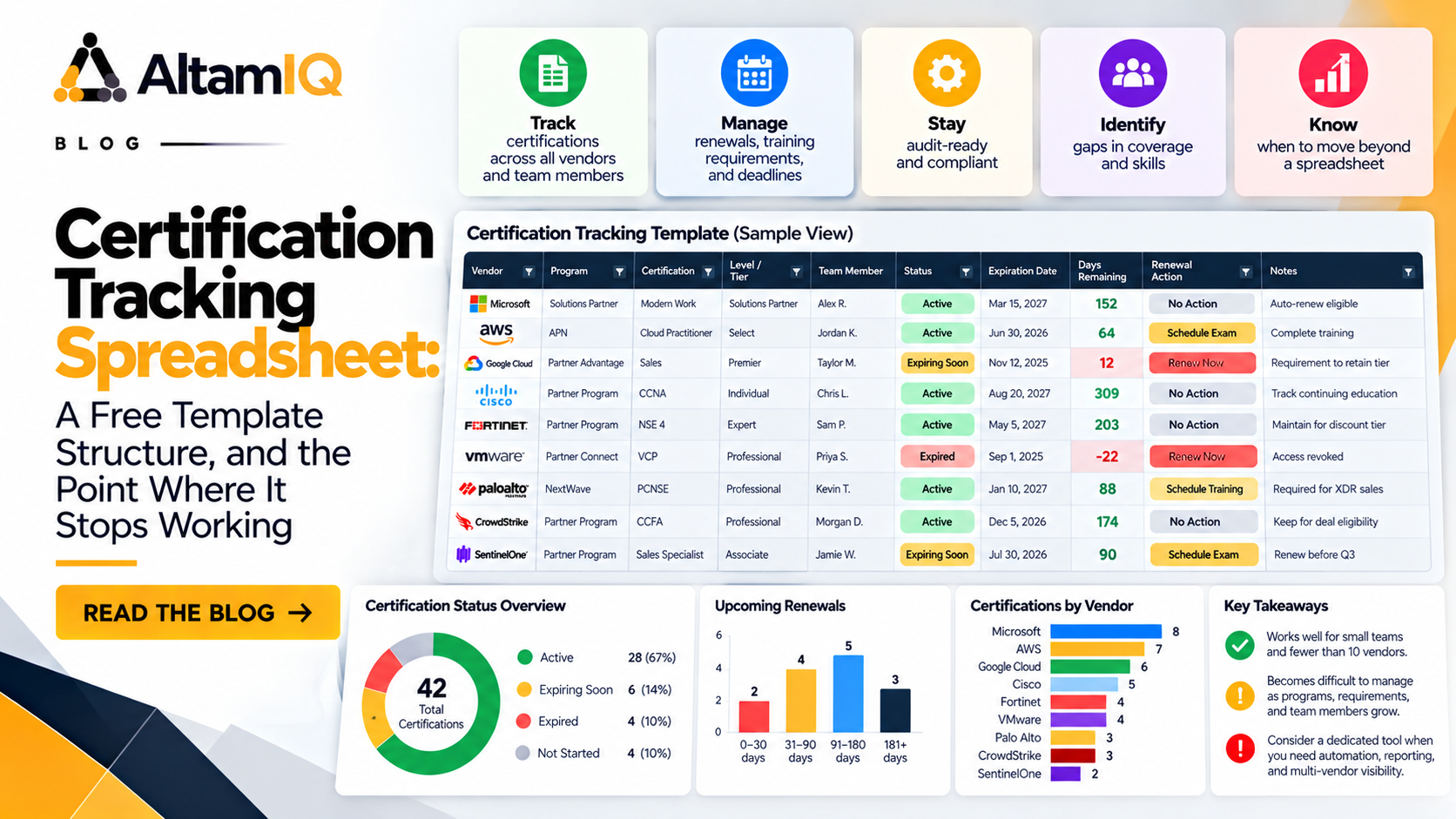
- List certifications by holder and expiry date, not by count. One row per certification: person, certification, date earned, expiry date, and whether the person is registered in Partner Central.
- Build the expiry heat map. Group expiries by quarter for the next eight quarters. If more than a third of your tier-qualifying certifications expire in one quarter, treat that quarter as a renewal project and plan it now.
- Flag single-point-of-failure holders. Identify anyone whose certifications, if lost, would drop you below a tier threshold. Treat their retention as a compliance dependency.
- Put the paperwork on the same calendar. The Partner Business Plan, the tier review, and any application window for the next tier belong next to certification expiries, not in someone’s inbox.
- Map cross-vendor dependencies. For each vendor, write down which other vendors’ status it relies on, and which rely on it.
What an expiry heat map looks like
| Quarter | Certs expiring | Remaining if none renewed | Against Premier (10) |
| Q1 2027 | 1 | 11 | Holds |
| Q2 2027 | 4 | 7 | Below Premier |
| Q3 2027 | 2 | 5 | Below Premier |
| Q4 2027 | 0 | 5 | Below Premier |
Illustrative only: a firm holding 12 tier-qualifying certifications. The specific numbers matter less than the shape. The answer to “are we Premier-ready?” changes by quarter.
No single AWS screen shows you that table. It exists only if someone builds it, which is why it is usually built the week after a renewal deadline has already been missed.
What to do this week
- Export your certified-individuals list from Partner Central and add an expiry date to every row.
- Find the quarter with the most expiries and decide who owns that renewal project.
- Check that every certified person is registered to the account.
- Put the AWS tier review date on the shared leadership calendar.
A 30-day plan to get your AWS standing under control
If you hold an AWS tier today, or are planning one, the fastest way to reduce risk is a short, structured sweep. It does not require new tooling. It requires one owner and four weeks.
| Week | Task | Output |
| 1 | Pull your current tier requirements from AWS Partner Central and write them in your own words. | A one-page requirements sheet |
| 2 | List every AWS certification your firm holds, by person, with the expiry date. | A people-to-credentials map |
| 3 | Compare the two. Where does a requirement rest on one or two people? | A short list of concentration risks |
| 4 | Assign owners and dates for each gap, and put the next review on the calendar. | A dated action plan |
The point of the exercise is not the paperwork. It is that the people who make decisions about training budgets and hiring can see, in one view, what your tier depends on.
Frequently asked questions
Do I need to hold every AWS tier requirement forever?
Tiers are assessed against the program’s current requirements, which AWS can change. Treat each requirement as something to monitor on a schedule, not something you earned once. Confirm current terms in the AWS Partner Network documentation.
Who should own AWS certifications inside the firm?
A named certification owner, not the individual engineers. Individuals hold the credential, but the firm needs one person who knows who holds what and when each item needs attention.
How does an AWS tier interact with other vendors?
Some vendor programs reference AWS status as a prerequisite for their own cloud-oriented tiers. Map those dependencies before changing your AWS standing.
Further reading
- AWS Services Partner Tiers requirements — AWS's own table of Select/Advanced/Premier requirements: foundational certified individuals 2/4/10, partner business plan from Advanced up, Premier needs sustained attainment over 6 months and an Executive Business Review. (aws.amazon.com)
- TechTarget overview of AWS Partner Network tiers — Independent overview: three APN tiers (Select, Advanced, Premier), $2,500 annual fee, MSP designation requires independent audit. (techtarget.com)
- ChannelE2E on AWS’s 2026 partner program updates — Dec 23, 2025 trade press report on AWS’s 2026 updates to its Solution Provider, Distribution, and MSP partner programs. These are separate from the services tiers discussed in this post. (channele2e.com)
- AWS certifications are valid three years — States AWS Certifications are valid for three years and can be renewed for three more. (aws.amazon.com)
- AWS recertification every three years — States certified individuals must recertify every three years. (aws.amazon.com)
AltamIQ: AltamIQ tracks certifications, tiers, and renewal dates for every vendor in your portfolio in one place, so “are we still Premier-ready in Q3?” has an answer that does not depend on a spreadsheet and one person’s memory. It is built for the partner side of the program: the firm holding the tiers, not the vendor running them.
Sources & verification
- Towards the Cloud, “Top 14 AWS Cloud Consulting Companies in 2026” (May 17, 2026) — https://towardsthecloud.com/blog/aws-cloud-consulting-companies
- AWS Services Path tier requirements guide, via Westcon-Comstor — https://www.westconcomstor.com/content/dam/wcgcom/Global/CorpSite/pdfs/services-path-tier-guide.pdf
- Fortinet Engage 2.0 Benefits and Requirements brochure, via Exclusive Networks — https://www.exclusive-networks.com/nl/wp-content/uploads/sites/21/2021/03/Fortinet-Partnerprogramma-Engage-2.0-Benefits-and-Requirements.pdf
- VERIFY BEFORE PUBLISHING: certification counts (2 / 4 / 10) and the six-month Premier rule come from third-party summaries of AWS documents. Confirm in AWS Partner Central. The three-year certification validity is AWS’s standard certification policy.