Google Cloud Partner Network 2027: What Select, Premier, and Diamond Demand from a Multi-Vendor Firm

Altamiq
In December 2025 Google Cloud announced the Google Cloud Partner Network, with a formal rollout in the first quarter of 2026. It replaces Partner Advantage and changes how partners are measured, not just what they are called. If you hold a Google Cloud status alongside AWS and Microsoft, this is the program change most likely to reshuffle your certification priorities this year.
What actually changed
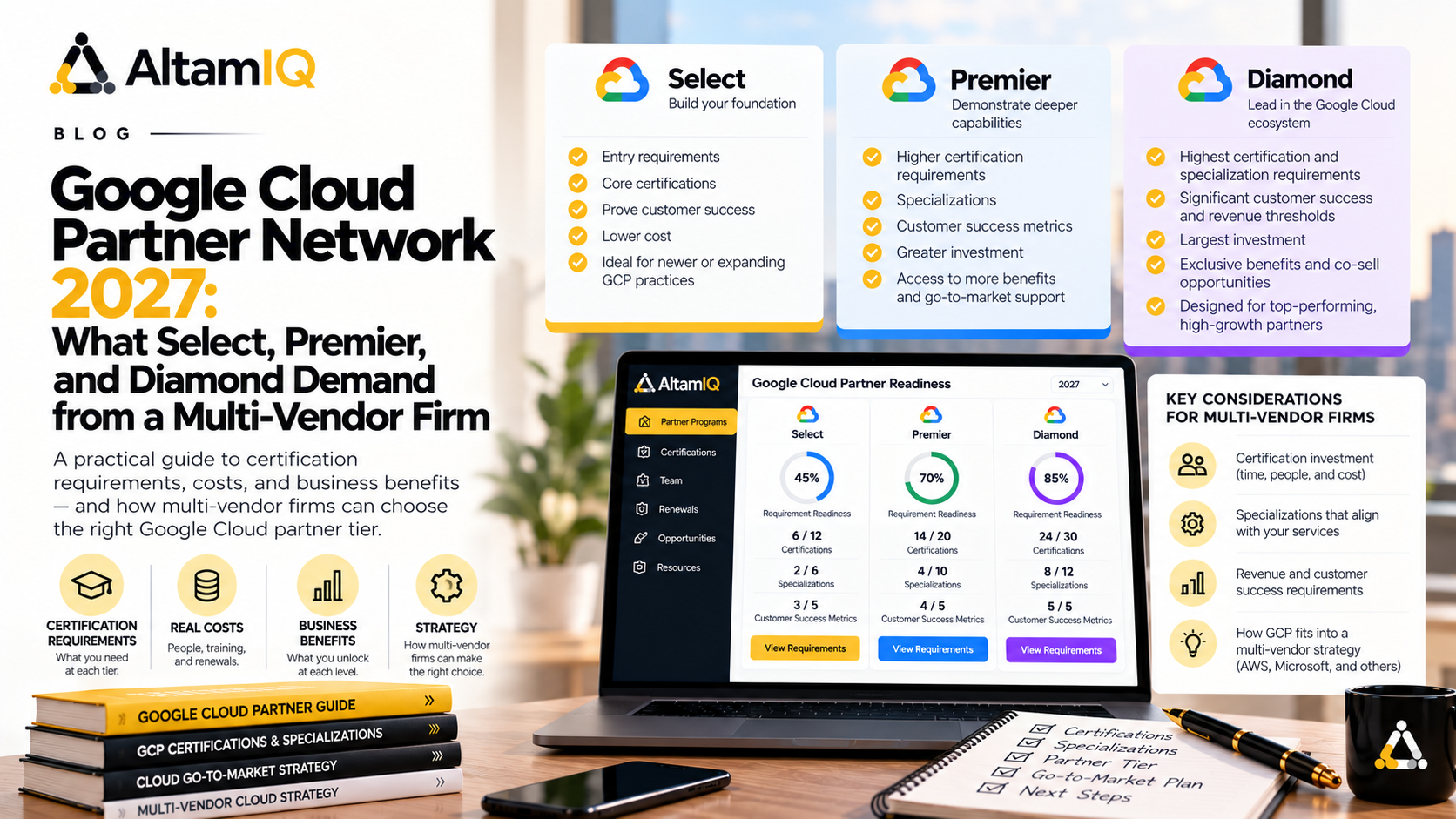
- Three tiers instead of two. Select, Premier, and a new Diamond tier that Google describes as intentionally selective, reserved for partners who consistently deliver exceptional customer outcomes.
- Contribution over paperwork. Google says it is moving away from tracking traditional program requirements such as business plans and customer stories, and toward recognizing pre-sales influence, co-innovation, and post-sales support.
- A new competency framework. It replaces the earlier specializations. Capacity covers skills and knowledge, validated by technical certifications and sales references. Competency covers success in the market, measured by pre- and post-sales contributions to validated closed or won deals.
- Automation. Google says successful projects and contributions count toward progress automatically and show up in real-time dashboards, with less manual reporting.
The thresholds being reported
Google’s public announcement does not publish tier thresholds. CRN Australia reports that partners must generate $20 million in partner co-sell ACV to reach Diamond, $2 million to reach Premier, and $250,000 to reach Select. It also reports that Diamond carries further milestones: 20 partner-implemented workloads, 30 co-sell-influenced opportunities, and 200 professional certifications. A GCP-focused analysis cites the same ACV figures. Treat all of these as reported, and confirm them in your own program portal.
| Tier | Reported co-sell ACV | Other reported milestones |
| Select | $250,000 | — |
| Premier | $2 million | — |
| Diamond | $20 million | 20 partner-implemented workloads; 30 co-sell-influenced opportunities; 200 professional certifications |
Source: CRN Australia (2026), corroborated on ACV figures by independent analysis. Not published by Google in the program announcement.
The 200-certification problem
The figure that drew the most pushback from partners was the certification count for Diamond. One consultancy founder told CRN Australia that large systems integrators could reach Diamond on headcount without the skill depth of a smaller specialist team, and that his own firm, at roughly 100 people, expected the climb to take about two years.
Run the arithmetic for a firm of that size: 200 certifications across 100 people is two per head. Now remember that the same engineers are also being asked to certify for AWS (ten foundational certifications for Premier on the Services Path), for Microsoft designations, and for whatever security vendors the firm resells. Certification hours are one finite budget with several vendors drawing on it. Which program gets the next hundred hours is a portfolio decision, whether or not anyone is treating it like one.
“Tracked automatically” is not the same as visible
Automatic tracking is genuinely useful, and it removes a reporting burden. But it lives inside Google’s portal. It can tell you how you are doing against Google. It cannot tell you how your Google progress compares with your AWS progress, or whether the engineers Google needs certified are the same ones AWS needs certified by the same quarter. The vendor dashboard answers “how am I doing with this vendor?” Only a view across the portfolio answers “where should the next certification hours go?”
Read Capacity and Competency as a map of what Google wants
One analysis of the new program argues that the competency structure is best read as a map of Google’s priorities rather than a checklist, and that partners who treat it as pure compliance tend to plateau once they have satisfied the requirements. That is worth taking seriously for planning. If the framework rewards validated co-sell and post-sale contribution, then the evidence trail for those contributions is as important as the certifications.
A Google tier-readiness worksheet
- Baseline co-sell ACV. Trailing twelve months of partner co-sell ACV, compared against the reported $250K, $2M, and $20M thresholds.
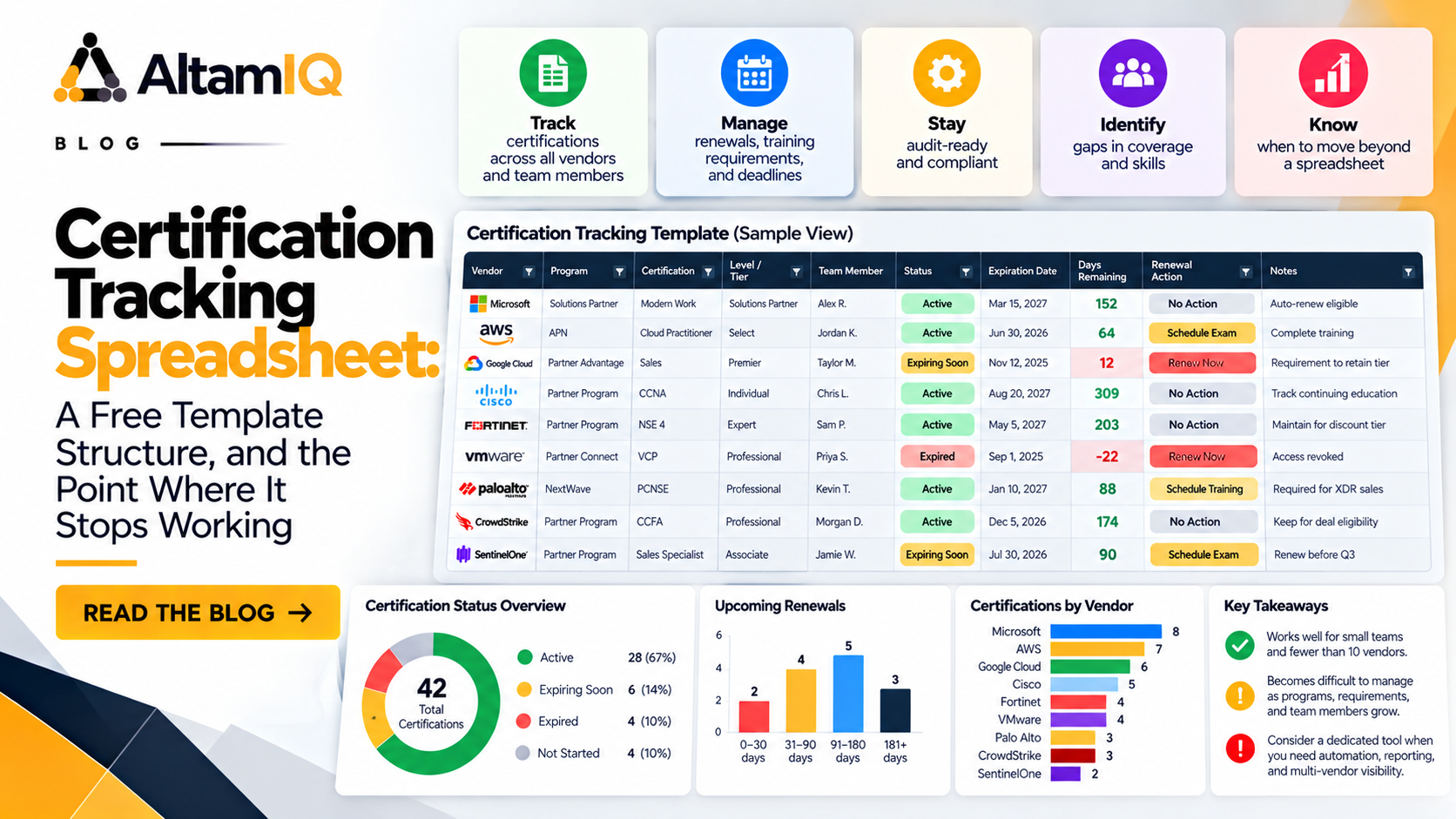
- Count certified practitioners. By certification, by person, with expiry dates. Remove anyone who has left.
- Keep an evidence log. Implemented workloads and co-sell-influenced opportunities, each with a date, a customer, and a record that Google can validate.
- Map target competencies to certifications. For each competency you want, list which certifications it needs and who holds them today.
- Decide whether Diamond is a goal or a distraction. Write down the certification hours it needs and which other program loses them.
Decision test: If reaching the next Google tier needs certification hours that your AWS or Microsoft renewals also need, name which program loses. Make it a decision instead of an accident.
Do not confuse it with Google’s other partner programs
The Google Cloud Partner Network is separate from the Google Ads Partners program, which keeps its Member, Partner, and Premier structure (Premier being the top few percent of agencies). Marketing agencies that hold both should track them as two programs with two sets of requirements, not one “Google status.”
What to do this week
- Confirm your current Google Cloud tier and which competencies, if any, you hold under the new framework.
- Pull the real tier thresholds from your program portal and compare them to the reported figures above.
- List every Google-relevant certification by holder and expiry date.
- Compare that list to your AWS and Microsoft lists to find the engineers carrying all three.
Where partners go wrong with cloud marketplace programs
Google Cloud, like the other hyperscalers, runs a partner program that mixes technical credentials, customer evidence, and commercial performance. Each of those has a different owner inside your firm, which is where problems start. Engineering owns the certifications. Sales owns the customer stories. Finance owns the revenue figures. Nobody owns the picture that combines them.
- Treating the program as a badge. A level is a statement about what you have done and can prove. If the proof is scattered, you will struggle to defend the level at the next review.
- Tracking requirements from memory. Requirements are rewritten between program years. The version your team remembers may no longer be current.
- Ignoring the interaction with other clouds. A firm certified on three clouds shares engineers across them. A departure, or a study sprint, affects all three at once.
- Leaving evidence to the last month. Customer references and case material take weeks to gather. Start when the requirement is announced.
A simple evidence file
Keep one folder per vendor program with the same four items inside: the requirements document with the date you read it, the list of credential holders with expiry dates, the customer evidence you have collected, and the next assessment date with the owner’s name. It takes an afternoon to build and saves days when an assessment arrives.
Frequently asked questions
Where should I look for the authoritative Google Cloud partner requirements?
Google Cloud’s own Partner Advantage documentation. Third-party summaries lag program changes, so use them only to know what to look for.
Should a small firm pursue a higher Google Cloud level?
Only after costing it. Use the tier return framework in our post on whether a partner tier is worth it, and apply the half test to the expected benefit.
What is the most common way partners lose standing?
Letting a requirement lapse unnoticed, usually a certification or a customer-success item that nobody owned.
Further reading
- Google's announcement of the new partner network — Google's Dec 16, 2025 announcement: Select/Premier/new Diamond tier, capacity and capability competency framework independent of tiers, Q1 2026 launch with six-month transition. (cloud.google.com)
- CRN on partner reaction to Diamond tier — CRN Australia: reported Diamond thresholds (about $20M co-sell ACV, 200 certifications, etc., per CRN's understanding) and mixed partner reactions; program launched globally Jan 15. (crn.com.au)
- Channel Insider on Google's 2026 program changes — Independent coverage: two tiers to three, specializations replaced by competencies (capacity/capability), Q1 2026 launch, more automation. (channelinsider.com)
- TechRadar on Google's new channel program — Dec 2025 report on Google’s new channel program: Q1 2026 launch, a six-month transition, and no guarantee that existing partners keep their current tier. (techradar.com)
- Devoteam named in Google's Diamond tier — Feb 17, 2026: confirms move to three tiers with Diamond on top; example partner placed in Diamond. (consultancy.eu)
AltamIQ: AltamIQ gives you the cross-vendor view the individual portals cannot: Google, AWS, Microsoft, and security vendors side by side, with certifications mapped to the people who hold them. It is partner portfolio management for the firm holding the tiers, which is a different job from the PRM a vendor uses to run its program.
Sources & verification
- Google Cloud, “Introducing Google Cloud Partner Network: What partners should know” (Dec 16, 2025) — https://cloud.google.com/blog/topics/partners/introducing-google-cloud-partner-network
- CRN Australia, “Google Cloud’s new three-tiering system brings mixed reviews from partners” (2026) — https://www.crn.com.au/news/2026/cloud/google-partner-program-tiering-system-changes
- Channel Insider, “Google Cloud Set to Launch Partner Program Updates in 2026” (Dec 30, 2025) — https://www.channelinsider.com/channel-business/vendor-leadership-and-partner-programs/google-cloud-partner-program-2026/
- Wyra, “The GCP Partner Advantage Paradox” — https://wyra.ai/resources/gcp-partner-advantage-paradox
- itreseller.ch coverage of the Capacity / Competency framework (Jan 6, 2026) — https://www.itreseller.ch/Artikel/104626/Google_Cloud_startet_mit_neuem_Partnerprogramm_ins_Jahr.html
- VERIFY BEFORE PUBLISHING: ACV thresholds and the Diamond milestone counts are press-reported, not published by Google. Confirm in the Google Cloud Partner Network portal.