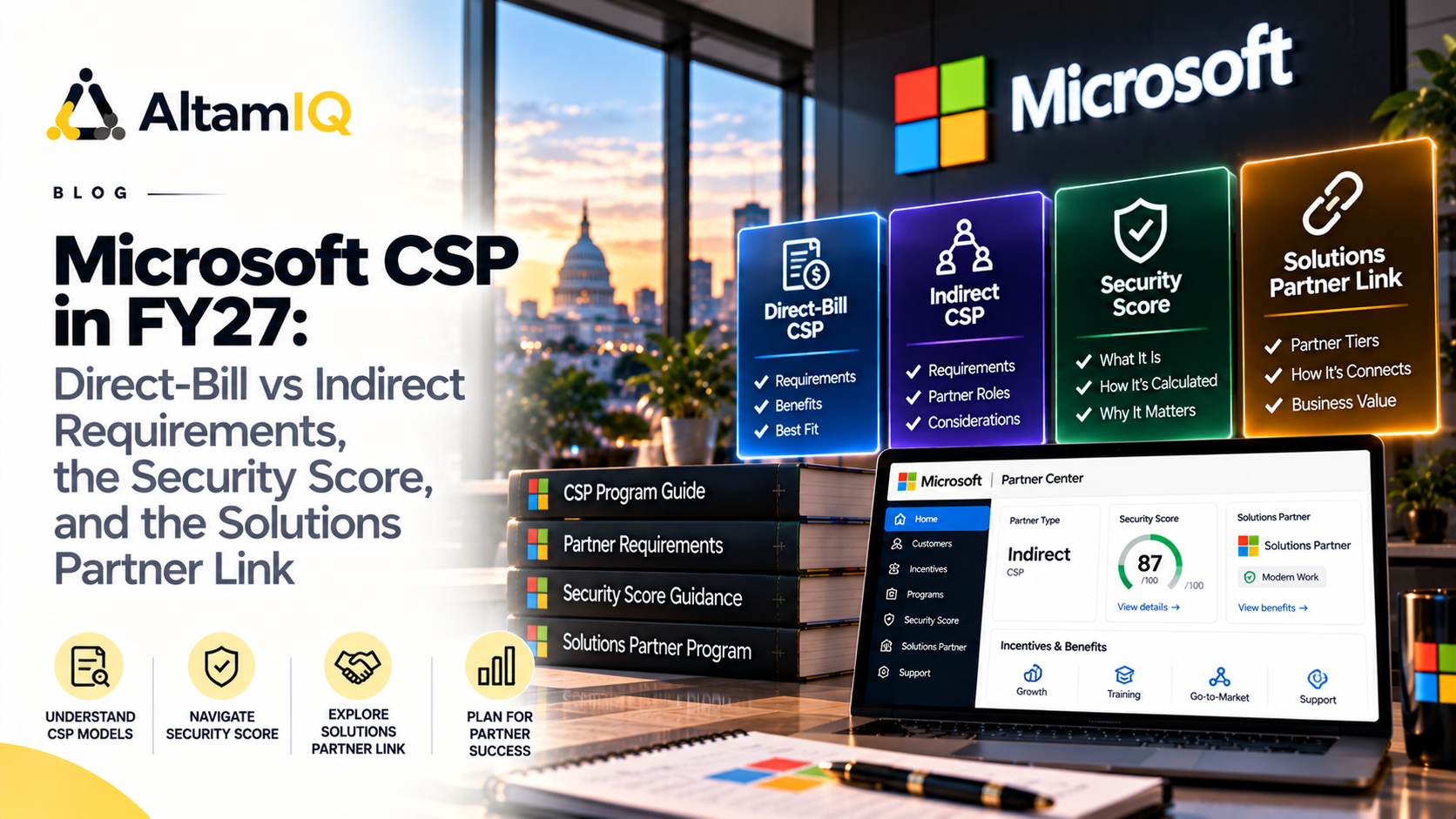
Microsoft CSP in FY27: Direct-Bill vs Indirect Requirements, the Security Score, and the Solutions Partner Link

Altamiq
Microsoft changed what it takes to stay authorized in the Cloud Solution Provider program, with new authorization requirements taking effect on October 1, 2025 as part of the FY27 program year. The changes touch direct-bill partners, distributors, and indirect resellers, and they affect both whether you can transact and whether you earn incentives.
The requirements below are drawn from Microsoft’s published guidance as summarized by distributors and partner-community sources. Where those sources disagree, this post says so. Treat the table as a checklist of what to verify in Partner Center, not as a substitute for it.
Authorization: what you must hold to keep transacting
| Area | Direct-bill partner | Indirect reseller |
| Revenue threshold | Reported as $1 million trailing-twelve-month CSP revenue. | A minimum trailing-twelve-month revenue requirement, reported in one source as $1,000. New resellers are not held to it until they complete 12 months. |
| Solutions Partner designation | At least one required. | Not required for authorization. |
| Security | Complete the mandatory Partner Center security requirements, including multifactor authentication for all administrative users and a named security contact. | Same mandatory security requirements. |
| Agreement | Accept the direct-bill Microsoft Partner Agreement. | Accept the indirect reseller Microsoft Partner Agreement. |
| Vetting and support | Capability assessment and an Advanced or Premier support plan, per partner-community summaries. | Business vetting. |
| If you fall short | Microsoft requires a transition to indirect reseller status. A partner that transitions must transact as an indirect reseller for twelve months before reapplying for direct bill. | A partner that does not meet all thresholds is not eligible to remain authorized and may reapply 12 months after offboarding. |
Sources: Work365, Ingram Micro, Kaseya, 4Sight, licenseq, and reseller.co.nz summaries of Microsoft guidance. The indirect revenue figure and support-plan details differ across sources. Verify in Partner Center.
Incentives are a second, separate gate
Being authorized to transact is not the same as being eligible for incentives. For FY27 Microsoft tied incentive eligibility to revenue and to either a Solutions Partner designation or points on the Partner Incentive Capability Score. As summarized by partner-community sources, direct-bill partners need $1 million in trailing revenue plus a designation, and indirect resellers need $25,000 in trailing revenue plus either a designation or 25 capability score points.
The designation also has to match the solution area. Modern Work incentives call for a Modern Work or Security designation. Business Applications incentives call for the Business Applications designation. Azure incentives call for Data & AI (Azure), Digital & App Innovation (Azure), or Infrastructure (Azure).
Two operating rules that are easy to overlook
- Partner-to-partner transfers are watched. Microsoft now monitors Change of Channel Partner activity, meaning customers moving between CSP partners, and has said it will not pay incentives on revenue that results from partner-to-partner transfers.
- The grace period on non-renewed subscriptions ended in spring 2026. Distributor guidance says the free grace period for accessing services on non-renewed subscriptions was discontinued. Sources give different dates, April 1 and May 4, so confirm the effective date that applies to you. The practical effect is the same: a missed renewal is now a service interruption for your customer.
The dependency chain: one lapsed certification can reach your CSP income
Follow the chain and you can see why CSP compliance is not a licensing problem alone.
- A certification or skilling requirement lapses for an engineer.
- Your Partner Capability Score for a Solutions Partner designation drops, and the designation is at risk at the next assessment.
- A direct-bill partner without a designation cannot stay direct-bill. An incentive-eligible partner without the right designation loses incentive eligibility in that solution area.
- The revenue the designation was protecting becomes harder to earn or keep.
Each step happens in a different part of Partner Center, and each is owned by a different person. The Solutions Partner designations are explained in our post on the six designations. The point here is that the CSP program and the designations are one system, even though they are managed as two.
A CSP compliance calendar
| Item | Cadence | Owner | Evidence to keep |
| Partner Center security requirements (MFA, security contact) | Continuous; check monthly | IT / security lead | Screenshot or export of status |
| Solutions Partner designation and score | Per Microsoft assessment | Practice lead | Score breakdown and certification list |
| Revenue against authorization threshold | Monthly | Finance or licensing lead | Trailing-twelve-month report |
| Incentive eligibility by solution area | Quarterly | Licensing lead | Designation or points per area |
| Microsoft Partner Agreement version | On change | Legal or operations | Accepted agreement and date |
| Subscription renewals | Monthly | Account manager | Renewal calendar by customer |
What to do this week
- Confirm in Partner Center whether you are authorized as direct-bill or indirect, and which requirements show as unmet.
- Check that MFA is enabled for every administrative user and that a security contact is named.
- Write down which Solutions Partner designations your incentives depend on, and the certifications behind each.
- Put the designation assessment date and your renewal review dates on one calendar.
A process for handling conflicting program information
Microsoft’s partner programs generate a steady stream of announcements, and an equally steady stream of third-party summaries. When those summaries disagree, partners need a way to decide what to act on. Here is a process that works for any vendor, not only Microsoft.
- Rank your sources. The vendor’s own announcement is the authority. Press coverage is a pointer to it. A reseller or distributor summary is a hint.
- Record the conflict. Write down what each source says and its date. A one-line note is enough.
- Resolve it at the source. Find the announcement and read the effective date yourself. If it is unclear, ask your partner contact in writing.
- Date your decision. Record which document and which version you relied on, so that a later change does not make your earlier planning look careless.
- Tell the people who act on it. Sales, delivery, and finance should hear one confirmed message, not three guesses.
What this means for CSP planning
Cloud Solution Provider status affects how you bill and support Microsoft customers, so changes carry commercial weight. Treat requirement changes as a project: identify what is affected, estimate the work, assign an owner, and set a date. A requirement you cannot meet by its effective date is a commercial risk, not an administrative one.
A habit worth keeping: Keep a running log of Microsoft partner announcements with the link, the date you read it, and the effective date. When sources disagree later, you can show what you knew and when.
A short readiness check for any CSP change
- What exactly is required, by what date, according to Microsoft’s own announcement?
- Which customers, subscriptions, and revenue does this affect?
- Who owns the work, and what does it cost in time and fees?
- What is the consequence of missing the date, and who has accepted that risk?
Answering these four questions in writing turns a vague worry into a plan, and it gives you something to show leadership when they ask where you stand.
Frequently asked questions
Why do sources disagree on CSP dates?
Secondary sources reported FY26 requirement dates inconsistently. Use Microsoft’s own Partner Center announcements as the authority and record the date you relied on.
Is CSP the same as a Solutions Partner designation?
No. They are related parts of Microsoft’s partner ecosystem with different requirements. Track each separately and note any dependency.
What should I do when moving customers between partners?
Check the current rules for transfers and any monitoring Microsoft applies, and confirm your own status before starting a move.
Further reading
- Microsoft's CSP authorization requirements (partner.microsoft.com)
- Channel Insider on Microsoft's partner changes — Independent trade-press coverage of the FY26 changes: direct-bill threshold rising from $300,000 to $1 million, a new $1,000 indirect-reseller threshold, and security scores above 80 for all partners. (channelinsider.com)
- ChannelE2E on CSP eligibility changes — Independent coverage of the October 2025 thresholds: $1M direct bill, $1,000 indirect minimum checked on tenant anniversary, $30M distributors, minimum security score of 80. (channele2e.com)
- direct-bill requirements and transition rules (learn.microsoft.com)
- Partner Center security requirements for CSP (learn.microsoft.com)
AltamIQ: AltamIQ connects the pieces Microsoft keeps in separate screens: certifications, designations, CSP requirements, and renewal dates, alongside every other vendor you carry. It is partner portfolio management for the firm holding the statuses, not a PRM for the vendor issuing them.
Sources & verification
- Work365, “Direct vs Indirect CSP: What Actually Changes for Your Business” — https://resources.work365apps.com/blog/direct-vs-indirect-csp-what-actually-changes-for-your-business
- CloudCockpit, “Microsoft CSP new program requirements” — https://cloudcockpit.com/blog/microsoft-csp-new-program-requirements
- Ingram Micro, “Stay Authorized as a Microsoft CSP Indirect Reseller” — https://apacs.ingrammicro.com/en-my/csp-authorization-requirements-for-indirect-resellers
- ITCloud, “New requirements for CSP indirect resellers” — https://www.itcloud.ca/en/new-requirements-for-csp-indirect-resellers/
- Reseller News NZ, coverage of CSP incentive and authorization requirements — https://www.reseller.co.nz/?p=3976831
- licenseq, “New Authorization Requirements for CSP Partners” — https://licenseq.com/?p=20768
- Kaseya, “Microsoft CSP Program changes” — https://www.kaseya.com/blog/microsoft-csp-program-changes/
- VERIFY BEFORE PUBLISHING: secondary sources disagree on the indirect revenue floor, the security score minimums, and the grace-period end date. Use Microsoft Learn and Partner Center as the final authority.