
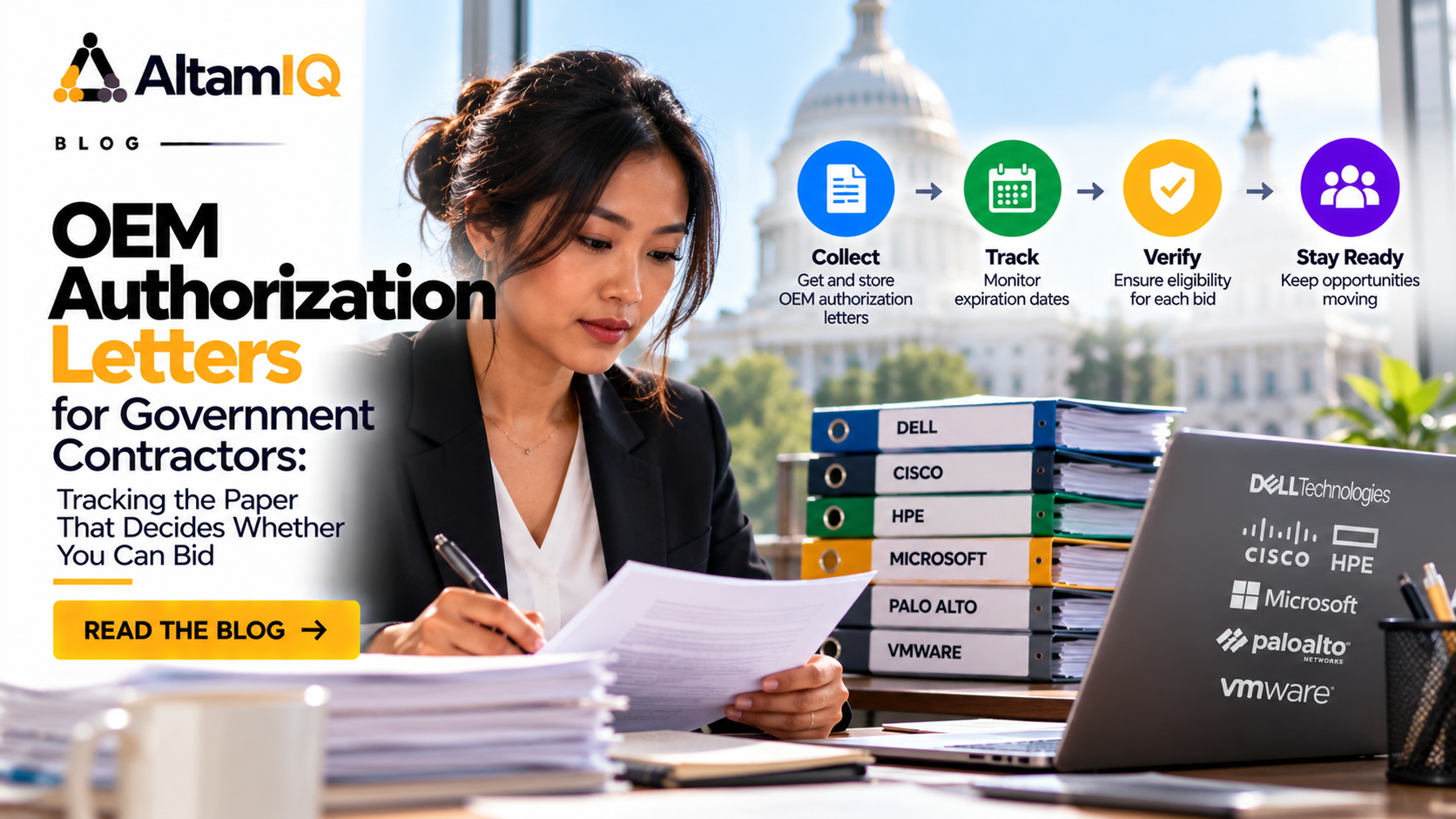
OEM Authorization Letters for Government Contractors: Tracking the Paper That Decides Whether You Can Bid

Altamiq
A government reseller can have the best price, the right contract vehicle, and a strong past-performance record, and still lose a bid on a single missing piece of paper. In many IT hardware and software solicitations, that paper is a letter from the manufacturer stating that you are authorized to sell its products.
This post covers what such letters are for, what the solicitations we reviewed actually say, and how to keep a portfolio of them current when you resell for many manufacturers.
What solicitations actually require
We reviewed public solicitation language rather than relying on summaries. Three patterns stood out.
- Authorization as a condition of the offer. Solicitations commonly require that the offeror be an OEM, authorized dealer, distributor, or reseller, and that the offeror prove it with a manufacturer authorization letter submitted with the quote.
- Omission can end the bid. One Department of Veterans Affairs solicitation (VA Pittsburgh) states that failure to provide the required documentation may eliminate the offeror from consideration.
- Supply chain detail. A U.S. Senate solicitation requires a manufacturer-signed Reseller Authorization Letter plus a supply chain risk management volume detailing the manufacturer’s status, such as OEM, authorized manufacturer, or authorized supplier.
Requirements vary by agency, solicitation, and contract vehicle, so treat these as examples of the pattern, not as a rule for every bid. Read the solicitation each time.
Why agencies ask
The concern behind the requirement is the gray market and counterfeit risk. A product bought outside the manufacturer’s authorized channel may lack warranty, support, firmware updates, or genuine components. For federal buyers, that is a security and supply chain issue, not only a commercial one. The letter is the manufacturer’s statement that your firm is in the authorized chain.
The tracking problem
| Problem | Why it happens | Consequence |
| Letter not on hand | It must be requested from each OEM, often per bid. | A quote cannot be submitted on time. |
| Expired or outdated letter | Letters can carry dates or be tied to a program status. | The letter is rejected or questioned. |
| Wrong scope | The letter covers some products, regions, or contract vehicles and not others. | The offer does not match the letter. |
| Status changed | You fell out of a tier or program the letter depended on. | The letter may no longer reflect reality. |
| Turnaround varies | Each OEM has its own process and timing. | Deadlines are missed because the request started late. |
A letter register that works
| OEM | Letter on file | Valid through | Scope | Request lead time |
| OEM A | Yes | Dec 31 | All products, federal | 3 days |
| OEM B | Yes | Expired | Hardware only | 10 days |
| OEM C | No | — | — | 5 days |
Illustrative. Record the validity and scope exactly as the letter states them, and the lead time from your own experience with each OEM.
Seven habits for GovCon resellers
- Keep a register of every OEM letter: date, validity, scope, signer, and where the file lives.
- Request early. Ask for letters when a solicitation is first reviewed, not when the quote is due.
- Match scope to the offer before submission: products, vehicle, and any region.
- Tie the letter to your program status. If your standing with the OEM changes, check whether the letter still holds.
- Log the lead time for each OEM so capture planning is realistic.
- Name an owner for the register, with a backup.
- Re-read the solicitation for any supply chain declarations alongside the letter.
Compliance note: This post describes patterns we found in public solicitations. It is not legal advice and not a substitute for the instructions in a particular solicitation or for guidance from your contracts counsel.
What to do this week
- Build the register for your top ten OEMs.
- Check any letter that has expired or has no stated validity.
- For each open pursuit, confirm the letter exists and matches the scope.
Building the authorization letter workflow
The risk with authorization letters is not that they are hard. It is that they are needed at the worst moment, with a deadline attached. A repeatable workflow removes the pressure.
- Trigger on solicitation review. The first time a solicitation is read, the reviewer checks for authorization letter and supply chain language. If it is there, a request is raised that day.
- Use a standard request. A short template naming the solicitation, the products, the contract vehicle, and the due date. Send it to the OEM contact on file.
- Track the request. Log the date sent, the contact, and the status. Chase after a set number of days.
- Check the letter on receipt. Verify the signer, the date, the scope, and any validity period against what the solicitation asks.
- File it in the register. Store the letter and record its details so that the next pursuit can reuse it where permitted.
Questions to ask each OEM once, in writing
- Do you issue standing letters, per-bid letters, or both?
- What is your typical turnaround, and is there an expedited route?
- Who signs, and does the signer change by product line?
- Do your letters carry an expiry or depend on our program status?
- Can you provide a supply chain statement describing your manufacturing and sourcing status?
Reducing gray market exposure in your own purchasing
Authorization is a promise about where your products come from. Make sure your own purchasing matches it. Buy from the OEM or its authorized distributors, keep invoices and purchase records, and avoid opportunistic sourcing from unvetted brokers, even when stock is short. A letter on file does not help if your purchasing history tells a different story.
A useful habit: For each government pursuit, keep a single folder holding the solicitation, the letter, and the purchase path. If an agency asks questions later, the answer is already assembled.
A note on subcontracting and teaming
If you bid as a subcontractor or in a teaming arrangement, the question of who needs the letter becomes more complicated. Read the solicitation to see whether the requirement attaches to the prime, to the entity supplying the product, or to both. Agree with your partner in writing who will request the letter and by when. Many problems come from each party assuming the other has it covered.
What to include in your internal bid checklist
- Authorization letter requested, received, and checked against scope.
- Supply chain declarations reviewed and completed where the solicitation asks.
- Manufacturer status recorded, such as OEM, authorized manufacturer, or authorized supplier.
- Purchase path confirmed as authorized, with records ready.
A scenario: the letter nobody requested
A GovCon reseller reviews a solicitation on Tuesday and sees a quote due Friday. The manufacturer typically takes several days to issue an authorization letter, and the capture lead only asks on Thursday. The quote goes out late or without the letter. Neither outcome depends on price. With a register that records each OEM’s usual lead time, the request would have been made on Tuesday.
Frequently asked questions
Is an authorization letter the same as a program tier?
No. A tier describes your standing in a vendor’s program. A letter is a specific statement that you are authorized to resell certain products, usually for a purpose.
Who signs the letter?
The solicitation tells you. In the Senate example we reviewed it had to be signed by the manufacturer. Always follow the solicitation language.
Should we ask for letters in advance?
Where the OEM allows, a standing letter with a clear scope and validity saves time. Ask what the OEM can provide, and record its limits.
Further reading
- FAR clause on counterfeit and nonconforming items — The FAR clause on reporting counterfeit and suspect counterfeit items, which defines counterfeit items by reference to the original manufacturer’s authority. It applies only where a solicitation includes it. (acquisition.gov)
- NIST guidance on supply chain risk management — NIST’s guidance on identifying, assessing, and mitigating supply chain risk, including counterfeit products. (csrc.nist.gov)
- CISA task force on authorized resellers — A 2019 CISA task force recommendation to encourage buying information and communications technology from manufacturers and authorized resellers. It was a proposal, not an adopted rule. (cisa.gov)
- Nextgov report on authorized-channel buying — Independent trade press report that the CISA-led task force unanimously approved a proposed rule pushing agencies to buy ICT only from manufacturers and their authorized channel partners. 2019 reporting. (nextgov.com)
- CISA fact sheet on ICT supply chain risk — CISA lists counterfeit components among ICT supply chain vulnerabilities and notes a task force working group studying how to encourage buying from original manufacturers or authorized resellers. (cisa.gov)
AltamIQ: AltamIQ is designed to keep a manufacturer’s standing with your firm next to the paperwork that depends on it, so authorization letters, program status, and certifications can be reviewed in one place before a bid, not during one.
Sources & verification
- Public federal solicitation language: VA Pittsburgh (OEM, authorized dealer, distributor, or reseller; manufacturer authorization letter; omission may eliminate offeror) and a U.S. Senate solicitation (manufacturer-signed Reseller Authorization Letter; SCRM volume). Locate and cite the exact notices and solicitation numbers on SAM.gov before publication.
- VERIFY BEFORE PUBLISHING: confirm the solicitation citations, and have counsel review the compliance statements. Requirements differ across agencies and vehicles.
- Keyword note: head terms have little measured volume. Target the long tail and the GovCon audience directly.