
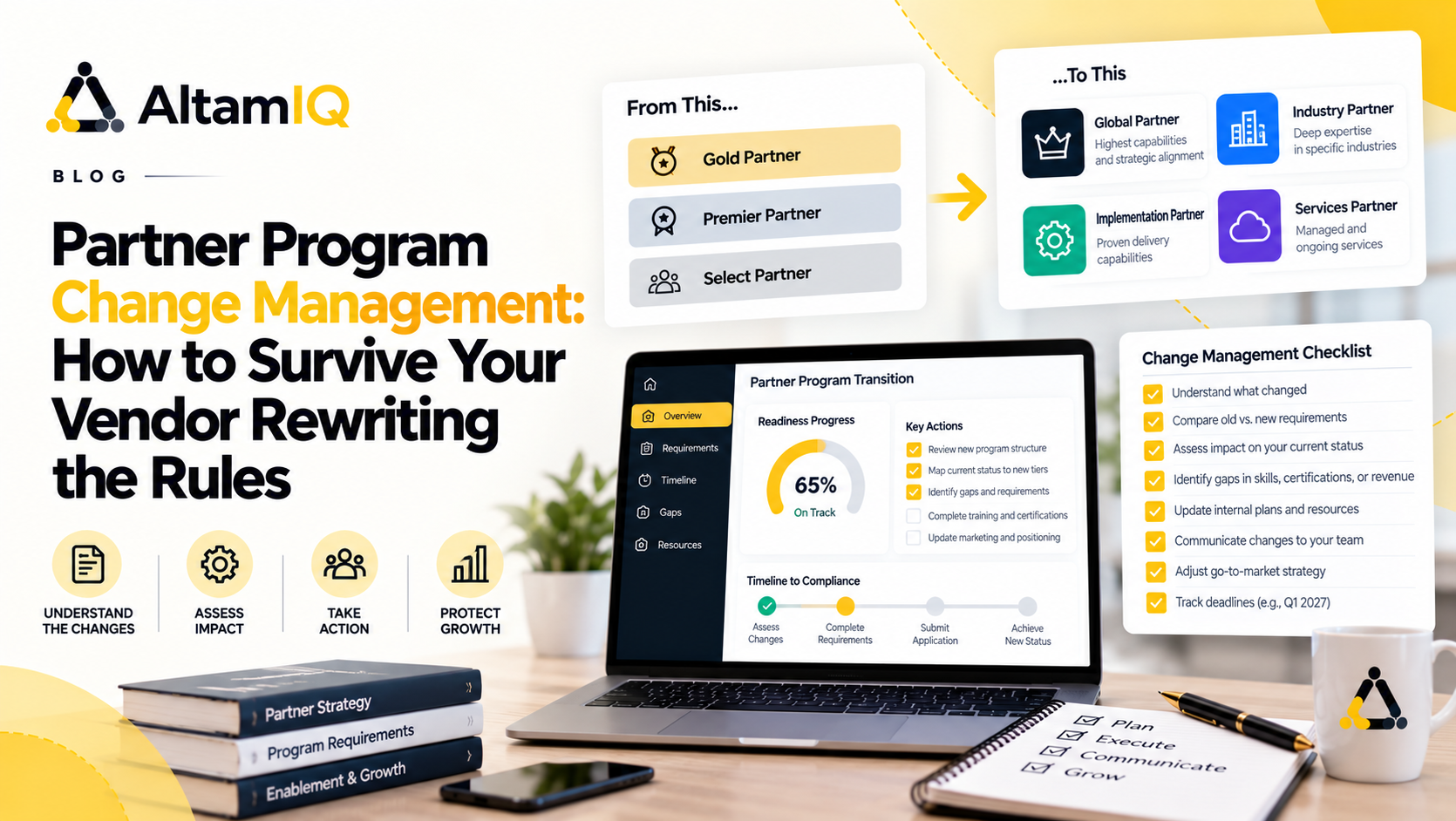
Partner Program Change Management: How to Survive Your Vendor Rewriting the Rules

Altamiq
Partner programs are not stable. Vendors restructure tiers, rename levels, move requirements, and change how benefits are earned, usually with a deadline attached and a message that sounds like an improvement. For the vendor, a program redesign is a strategic decision. For the partner, it is an unplanned project.
Recent examples show the pattern
- Cisco retired its Gold, Premier, and Select integrator tiers in January 2026 as part of its 360 Partner Program.
- Salesforce consolidated 170 badges (its own documents call them Navigator distinctions) into 28 competencies in March 2026.
- Palo Alto Networks has described its NextWave program as being updated, including changes to how discounts and incentives are applied at quoting.
- Microsoft has published changes to its Cloud Solution Provider requirements for FY26; dates and details have been reported inconsistently, so partners should check Microsoft’s own documents.
The details of any one change matter less than the shape of them. A change arrives, a deadline follows, and the partner learns what it costs only by working it out.
A five-stage response
- Detect. Know about the change when it is announced. Name someone to watch each vendor’s announcements, and subscribe a shared mailbox, not one person’s inbox.
- Translate. Rewrite the change in terms of your firm: which tiers, certifications, funds, and clients are affected? A vendor’s summary says what changed. You need to know what it means for you.
- Price. Estimate the cost of complying: certifications, hours, fees, revenue at risk. Include the cost of not complying.
- Decide. Choose to comply, adapt, or step back. Record the reasoning.
- Execute and verify. Assign owners and dates, then confirm with the vendor that your status reflects the outcome.
A change log template
| Vendor | Change | Effective date | Our exposure | Decision and owner |
| Vendor A | Tier renamed, requirements revised | Date from announcement | Two certifications; one fund | Adapt / delivery manager |
| Vendor B | Benefit moved to higher tier | Date from announcement | Loses a rebate | Review at next QBR |
| Vendor C | New registration rules | Date from announcement | Process change | Comply / sales ops |
Illustrative entries. Always record the effective date as stated in the vendor’s own communication.
Questions to ask the vendor when a change lands
- Does my current status carry over, and on what date does that stop?
- Is there a grace or transition period, and does it apply to me?
- Which of my existing certifications still count?
- What happens to funds, rebates, and registrations already in progress?
- Is the new structure documented anywhere I can cite?
Guard against the usual failure modes
- Reading the headline only. The consequential detail is usually in the requirements document.
- Waiting for the renewal. The cost of a change often arrives at the next assessment, long after the announcement.
- Treating it as the vendor’s problem. The vendor has told you. The responsibility to act is yours.
- Forgetting to tell the team. Engineers, sales, and finance may all be affected.
Track the track record: Count how many times each vendor has materially changed its program in the last 24 months. It belongs on the vendor scorecard, because volatility is a cost.
Building the change log in practice
The log is the backbone of the process. It does not need to be elaborate. It needs to be complete, current, and visible.
| Field | What to record |
| Vendor and program | Which relationship the change belongs to. |
| Announcement | Link to the source and the date you read it. |
| Effective date | The date the change takes effect, as the vendor states it. |
| What changed | Two sentences in plain language. |
| Exposure | Tiers, certifications, funds, registrations, and clients affected. |
| Cost to comply | Time and money, with the cost of not complying beside it. |
| Decision and owner | Comply, adapt, or step back, and who is responsible. |
| Verified with vendor | Date and form of confirmation that your status reflects the outcome. |
How to brief your team
Keep the message short and specific. Start with what changed and when. Then state what it means for your firm: which tiers, credentials, and funds are affected. End with what you need from each person and by what date. Avoid forwarding the vendor’s announcement without comment. People skim vendor communications, and the real implication is rarely in the headline.
Using change history as a decision input
Over time the log becomes evidence. If a vendor has changed its program three times in two years, each time adding cost, that pattern belongs in your scorecard and in your tier decisions. It also gives you a fact-based basis for conversations with the vendor about notice periods and transition support. Vendors take feedback more seriously when it is specific, dated, and costed.
Roles in a change response
| Role | Responsibility | Typical owner |
| Watcher | Monitors vendor announcements and logs them. | Alliance owner or deputy |
| Assessor | Determines which tiers, credentials, funds, and clients are affected. | Vendor owner |
| Decision maker | Chooses to comply, adapt, or step back. | Sponsor |
| Implementer | Carries out the plan to the date. | Delivery or operations |
| Communicator | Briefs staff and clients. | Alliance owner |
In a small firm one person may hold several of these roles. The roles still need to be named, so that nothing falls between them.
Planning for the next change before it arrives
- Keep margin. Slack in certifications, time, and budget makes any change cheaper.
- Keep records current. A change is easier to assess if you already know your status.
- Keep relationships warm. Partner managers who know you tend to give early warning.
- Keep options. A portfolio with alternatives is less exposed to any single vendor’s decisions.
Change is the norm in partner programs. The goal is not to prevent it, but to make your firm cheap to change.
A worked example: a tier is restructured
Imagine a vendor announces that its middle tier will be replaced by two new levels, effective at the end of the year. The firm holds the middle tier today, relies on its discount, and has four people certified against its requirements.
- Detect. The watcher logs the announcement the day it arrives, with the link and the effective date.
- Translate. The vendor owner reads the requirements for both new levels and compares them with the firm’s current people, revenue, and customer evidence.
- Price. One level needs two more certified people and one more reference. The other needs less but offers a smaller discount. The firm estimates the cost of each, and the margin at stake.
- Decide. The sponsor chooses the lower level for now and schedules a review in six months, recording the reasons.
- Execute. The firm confirms the transition date with the vendor, tells sales how quoting changes, and updates its tier plan.
The whole sequence takes a few weeks, and none of it depends on guessing what the vendor will do next. It depends on knowing your own position and having a routine for acting on it. The firm that has no routine will reach the same decision, but probably later, at higher cost, and under more pressure.
The lesson: The quality of your response to a change is set long before the change arrives. It depends on how current your records are and how clearly your roles are defined.
A scenario: the announcement and the quarter that followed
A vendor announces that one tier will be restructured at the end of the year. A firm with a change log logs it that week, finds that two certifications and a fund are affected, prices the response, and decides to adapt. A firm without one reads the announcement, agrees it is important, and learns the cost at the next assessment. The programs and the announcement are the same. The outcomes differ by process.
Frequently asked questions
Who should read vendor announcements?
A named person for each vendor, with a shared mailbox so coverage survives holidays and departures.
How quickly should we respond?
Assess within a week, decide at the next review, and put the effective date on the calendar immediately.
Should we resist changes?
You can raise concerns through your partner manager, but plan for the change as announced.
Further reading
- Cisco's announcement of the 360 program — Cisco primary source: announces 360 program, new Cisco Partner and Preferred Partner designations, sunset of Gold/Premier/Select, merged incentives; announced effective Feb 1, 2026. (blogs.cisco.com)
- trade press on Cisco 360 overhaul — Trade press: 360 replaces Select/Premier/Gold and four roles with two tiers, adds Partner Value Index, effective Feb 1, 2026 with 15+ months notice. (channelbuzz.ca)
- partners react to Cisco removing Gold — CRN Australia: partner reactions to Gold's removal, some expecting impact on prior Gold holders and others finding transition seamless. (crn.com.au)
- Salesforce FY27 consulting partner program — Salesforce’s own brochure for its FY27 consulting partner program: four tiers become two, and 28 competencies replace 170 Navigator distinctions. (salesforce.com)
- analyst view of Salesforce partner overhaul — Analyst commentary on Salesforce’s overhaul: 170 distinctions consolidated into 28 competencies and tiers cut to two. (futurumgroup.com)
AltamIQ: AltamIQ gives you the change log, the exposure map, and the owners in one place. When a vendor rewrites the rules, you see immediately which tiers, certifications, and funds are affected, and who is responsible for the response.
Sources & verification
- Cisco 360 Partner Program (Gold, Premier, Select retired Jan 2026), Salesforce 170 badges to 28 competencies (Mar 2026), Palo Alto NextWave updates (company blog), Microsoft CSP FY26 requirements: see sources for posts 5, 6, 13 and 16.
- VERIFY BEFORE PUBLISHING: re-check every dated claim against vendor primary sources. Microsoft CSP dates were reported inconsistently across secondary sources.
- Keyword note: “partner program changes” is a broad phrase. Validate volume before committing the primary keyword.