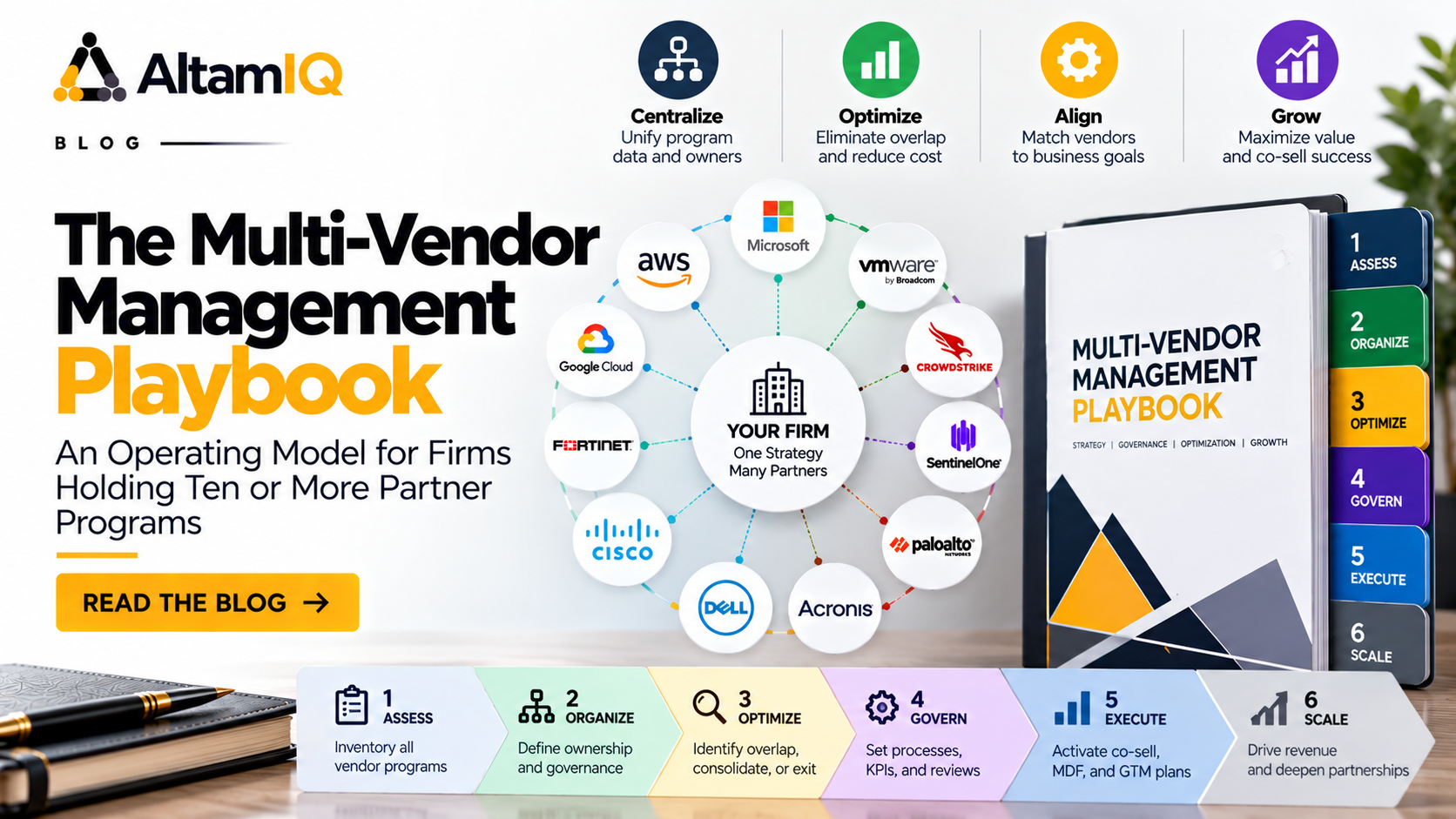
The Multi-Vendor Management Playbook: An Operating Model for Firms Holding Ten or More Partner Programs

Altamiq
Somewhere between three and ten vendor programs, partner management stops being a side task and becomes an operation. The warning signs are familiar: a renewal discovered late, a certification found expired during a bid, a program change that only one person read. These are not individual failures. They are what happens when an operation runs without an operating model.
This playbook describes a minimal one. It has four parts: a single source of truth, clear roles, a fixed cadence, and a change process.
Part 1: One source of truth
Each vendor portal holds a slice of the truth about your standing with that vendor. None holds the whole picture. The first rule of the model is that one record, owned by your firm, holds the cross-vendor view.
- Per vendor: current tier or status, requirements for that tier, the next assessment date, relationship owner, agreement renewal date.
- Per requirement: the certification or metric, who holds it, the expiry or measurement date, the cost to renew.
- Per person: the certifications they hold, across all vendors, and their renewal dates.
- Per change: the vendor announcement, the effective date, and who reviewed it.
Part 2: Roles
| Role | Responsibility | Who usually holds it |
| Portfolio owner | Owns the cross-vendor record, runs the cadence, reports to leadership. | Alliance manager, or COO in a smaller firm |
| Vendor owner | Owns one relationship: contact, requirements, reviews, renewals. | A practice lead or senior engineer |
| Certification owner | Plans and tracks who certifies when. | Delivery manager or training lead |
| Sponsor | Makes the invest, hold, or exit call. | Managing director or CEO |
A small firm may combine these. Combine the people, not the responsibilities.
Part 3: Cadence
| Frequency | Activity | Output | Owner |
| Weekly | Scan program announcements and expiring items | Short change and expiry list | Portfolio owner |
| Monthly | Review certification and registration expiries 90 and 30 days out | Renewal plan | Certification owner |
| Quarterly | Vendor business reviews and tier progress | Updated tier plan per vendor | Vendor owners |
| Twice a year | Scorecard and portfolio review | Invest, hold, or exit decisions | Sponsor |
Part 4: A change process
Vendors change programs on their own schedule, and the changes are often significant. Cisco retired its Gold, Premier, and Select integrator tiers in January 2026. Salesforce replaced 170 badges with 28 competencies in March 2026. Whatever the next change is, the question is how quickly your firm learns about it and works out what it costs.
- Capture every announcement in the log the day it is seen, with the effective date.
- Assess within a week: which of our tiers, certifications, and funds are affected?
- Decide whether to comply, adapt, or step back.
- Communicate to affected people and clients.
- Record what it cost and what was decided, for the scorecard.
Signs your model is working
- Nobody is surprised by an expiry.
- Any partner can answer “where do we stand with Vendor X?” without opening a portal.
- Program changes reach a decision-maker within days.
- You can say which vendors you would drop first, and why.
Start small: You do not need all four parts at once. If you build only one this month, build the single record. The other three depend on it.
What to do this week
- Name the portfolio owner.
- List your vendors in one table with tier, next assessment date, and owner.
- Schedule the first weekly change scan.
Starting from zero: the first 60 days
If you are building this operating model for the first time, resist the urge to design everything at once. Sequence it.
| Period | Focus | Result |
| Days 1–15 | Inventory every vendor program, owner, tier, and next assessment date. | A first version of the single record |
| Days 16–30 | Name the portfolio owner and a vendor owner per core vendor. | Clear accountability |
| Days 31–45 | Start the weekly change scan and the monthly expiry review. | The first two rhythms running |
| Days 46–60 | Hold the first quarterly review for your top vendors. | The first set of decisions |
Common obstacles
- “We do not have time.” The model replaces time spent firefighting. Start with the weekly scan, which takes under an hour.
- “The vendors will not give us this information.” Much of it is already in your agreements and portals. Gather what you have first.
- “One person already knows it all.” That is the risk. Knowledge held by one person is not an operating model.
- “Leadership does not ask for it.” Produce one simple view and put it in the next leadership meeting.
How to know it is working
Track three measures: surprises (an expiry, a registration, or a program change you learned about late), time to answer a standing question such as “where do we stand with this vendor,” and the share of vendors with a current tier plan. Surprises should fall to near zero, the time to answer should fall to minutes, and every core vendor should have a plan.
A one-page portfolio view for leadership
Leadership does not need the full record. It needs a single page that shows, for each vendor, five things: the current status, the next assessment date, the main risk, the owner, and the recommended action. Sort the page by risk, so that the vendors needing attention come first. Review it at every leadership meeting for five minutes.
| Vendor | Status | Next date | Main risk | Action |
| Vendor A | Premier | Mar 31 | Two-person dependency | Train a third |
| Vendor B | Advanced | Jun 15 | Program change pending | Assess by May |
| Vendor C | Select | Sep 1 | Low return | Review for exit |
Illustrative.
The page does two jobs. It keeps leadership informed without drowning them, and it makes the portfolio owner’s work visible, which helps the role keep its authority.
Keeping the model alive
Operating models decay. People change roles, new vendors are added without a handover, and the weekly scan slips. Schedule a short annual check: is each role filled, does each rhythm still happen, and is the single record still current? Treat gaps as the early warning they are.
Choosing tools for the operating model
The model does not depend on a particular tool. Many firms begin with a shared spreadsheet and a calendar, then move to something more specialized when the number of vendors and people outgrows it. Choose tools by the questions they need to answer: what are we required to do, who holds what, and what changes next? Prefer one place over several, and prefer a tool that your team will actually update over one that merely looks impressive.
Whatever you use, run the same quarterly test. Pick a vendor at random and ask whether you could assemble its full status, risks, and dates in five minutes. If not, the record is not yet doing its job.
A scenario: the same week, with and without the model
Without an operating model, a program change is spotted by one engineer, mentioned in a chat, and forgotten until an assessment. With the model, the weekly scan logs it, the portfolio owner assesses it within a week, the sponsor decides at the next review, and the vendor owner updates the tier plan. The announcement is identical. What differs is whether anyone was responsible for noticing.
Frequently asked questions
What is the smallest viable version?
A single table listing every vendor with tier, next assessment date, owner, and a weekly 20-minute scan of announcements.
Who should be the portfolio owner in a small firm?
Whoever already holds the most vendor relationships and has authority to ask for information across teams.
How does this relate to a PRM?
A PRM is software a vendor runs to manage its partners. This model is the partner’s own view across its vendors.
Further reading
- Cisco's partner designations FAQ — Cisco states it retired the Gold, Premier and Select partner levels on January 24, 2026, with new designations (e.g. Portfolio Partner, Preferred Partner) effective January 25, 2026. (cisco.com)
- Salesforce replaced 170 badges with 28 competencies — Salesforce-ecosystem press coverage of the overhaul: badges replaced by competencies and four tiers consolidated to two. (salesforceben.com)
- CompTIA State of the Channel findings — CompTIA State of the Channel 2024 finds more firms with one to four vendor programs and higher partner satisfaction. (connect.comptia.org)
- ISACA on vendor roles and monitoring — ISACA on clarifying vendor roles, grouping vendors by risk, and monitoring them on an ongoing basis. (isaca.org)
- Deloitte on holistic supplier management — Deloitte’s chief procurement officer survey: a case for managing suppliers holistically, with 18% of CPOs formally tracking risk in their tier 1 supplier base. (deloitte.com)
AltamIQ: AltamIQ is the single record this playbook depends on: a partner-side portfolio of every vendor, requirement, certification, owner, and change, with the cadence built in. It is partner portfolio management for the firm holding the programs.
Sources & verification
- Cisco 360 Partner Program change (Gold, Premier, Select retired Jan 2026) and Salesforce 170-to-28 consolidation (Mar 2026): see sources for posts 5 and 6.
- Keyword validation: Ahrefs Keywords Explorer, US — “multi-vendor management” 100 searches per month, KD 1, CPC about $3.
- The operating model is original to this post.